
Strap yourself in tightly because this is one fast rollercoaster ride. Dan Brown is at it again, this time exploring the nature of consciousness. The Secret of Secrets philosophical musings encourage us to think of consciousness as fluid and unmoored from our mortal coils. And the rocket plot features murder(s), a shadowy agency, foot chases, political shenanigans, and the usual assortment of secret passages and cryptic messages.
Schedule extra time for book club because this 700 page book requires it. And get the conversation started with our book club questions for The Secret of Secrets. The discussion guide includes prompts, a synopsis, and some selected reviews (not everyone loved it!). But if you did love it, we’ve got some suggestions for what to read next.

(This article contains affiliate links. This means that if you choose to purchase, I’ll make a small commission.)
Synopsis for The Secret of Secrets
(I always choose to provide the publisher synopsis because I feel that it’s worthwhile to discuss whether the official book description actually squared with your experience of the book.)
The Secret of Secrets, Dan Brown
Robert Langdon, esteemed professor of symbology, travels to Prague to attend a groundbreaking lecture by Katherine Solomon—a prominent noetic scientist with whom he has recently begun a relationship. Katherine is on the verge of publishing an explosive book that contains startling discoveries about the nature of human consciousness and threatens to disrupt centuries of established belief. But a brutal murder catapults the trip into chaos, and Katherine suddenly disappears along with her manuscript.
Langdon finds himself targeted by a powerful organization and hunted by a chilling assailant sprung from Prague’s most ancient mythology. As the plot expands into London and New York, Langdon desperately searches for Katherine . . . and for answers. In a thrilling race through the dual worlds of futuristic science and mystical lore, he uncovers a shocking truth about a secret project that will forever change the way we think about the human mind.
10 Book Club Questions for The Secret of Secrets
These questions have been tailored to this book’s specific reading experience, but if you want more ideas, I also have an article with 101 generic book club questions.
- “The most important point in the research, however, shows that those who do not fear death, for whatever reason, tend to exhibit behavior that is more benevolent, accepting of others, cooperative, and caring about the environment. Essentially, this means that if we could all free our minds of the burden, of the terror we feel about death…” “Then we would find ourselves in a dramatically improved world.”
Does this ring true to you? Do you think that people who believe in an afterlife or reincarnation tend to exhibit more benevolent behaviors? - The Langdon series is known for is propulsive plots. There are also lots of chases, some shadowy organizations, secret passages, cryptic messages and the like. Did those tropes work in this book? Why or why not?
- “When we lose ourselves in the virtual world,” Katherine said, “we are giving ourselves a kind of nonlocal experience that, in many ways, parallels an out-of-body experience—we are detached, weightless, and yet connected to all things. Our filters are dropped…We can interact with the entire world through one screen and experience almost anything.”
There is a lot of prevailing sentiment in our culture that screen time, online gaming and social media are bad. Yet, in this quote, Brown presents a rather opposite viewpoint. What do you think? - The epigraph says “The day science begins to study non-physical phenomena, it will make more progress in one decade than in all the previous centuries. —Nikola Tesla”
Do you agree? - At the beginning of the book, Brown notes facts, such as how the artwork, artifacts, documents, experiments and organizations are real. And then he spins the reality into fiction. Are you able to separate the fact from the fiction? Is he doing a good job of it?
- Brown uses multiple points-of-view to reveal elements of the mystery and move the plot along. Did that work for you? Would you prefer to have just one POV?
- Brown mentions actual companies who are developing cranial chips and similar technology (such as Neuralink). Do you believe that we’re close to achieving this? And if yes, how do you feel about it?
- So, Sasha is our golem. Did you guess?
- How did you react to the notion that high GABA levels inhibit the wider reality from entering our consciousness. Are we in the Matrix?
- Or rather, is Katherine really talking about The Force? I mean, there’s an R2D2 vent after all.
Selected Reviews for The Secret of Secrets
Use these selected Goodreads reviews to compare with your own experience of the book. Do you agree or disagree with the reviews?
“700 pages? is Dan Brown trying to kill me?”
“Langdon has aged and shown his abilities throughout the series, which is not lost here, though he appears more out of his element at times. Symbols and religious connections are less prominent, though his ability to learn will impress many. Katherine Solomon proves a great addition to the series once more, not only for her romantic connection to Langdon, but her expertise opens new and confusing topics for the reader to enjoy.”
“When I hit another “what if” my reaction was, Okay… so what? There was no spark, and nothing new (just the same ideas that other authors have implanted in minds until now). Just more name-dropping and a mishmash of science crammed into the book to make it sound deep.”
“Brown’s formula of employing richly atmospheric settings and cliffhangers at the end of each chapter creates a sense of urgency, compelling readers to continue turning pages late into the night.”
“The Secret of Secrets represents Dan Brown at his most intellectually ambitious, successfully expanding the Langdon universe into new scientific territories while maintaining the historical intrigue and breakneck pacing that define the series. The novel’s exploration of consciousness research adds genuine philosophical depth to the thriller framework, creating a reading experience that entertains while provoking thought about fundamental questions of human existence.”
“Does it make sense? Absolutely not. But since when has “making sense” been a requirement for a Dan Brown novel? Reality in this book is more like an optional suggestion, loosely waved at before the characters sprint off to the next set piece. The pacing is relentless—mostly because if you stopped to think about the logic for more than three seconds, you’d burst out laughing.”
What to Read Next
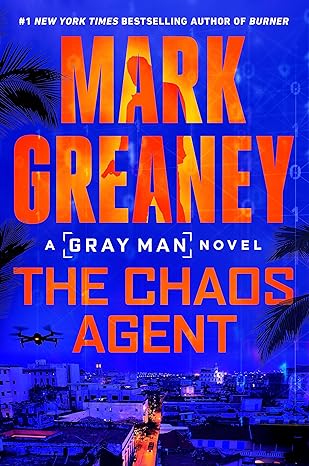
The Chaos Agent, Mark Greaney
Fast paced, check. On the run, check. Advanced technology, check check check.
The Chaos Agent follows elite operative Court Gentry—known as the Gray Man—as he confronts a shadowy conspiracy tied to cutting-edge bioweapons and global power players. In this latest installment of the Gray Man series, artificial intelligence leads to a shocking and alarming scenario. Someone is killing the world’s leading experts on artificial intelligence and robotics. Is it a tech company eliminating the competition, a country intent on military superiority, or something even more ominous?
Gentry is pulled into a mission with complex moral lines, political corruption, covert agendas and high stakes.
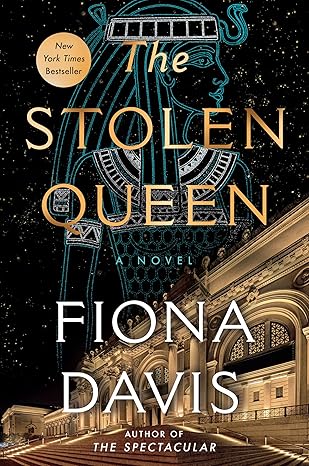
The Stolen Queen, Fiona Davis
If you’re down with Brown’s new romance angle, but you still want artifacts and intrigue, The Stolen Queen is a good pick.
The plot intertwines two timelines connected by the Metropolitan Museum of Art’s Egyptian collection. In 1913, Charlotte Cross scores a spot on a coveted archeological dig in Egypt. The team finds…and then loses a royal artifact tied to Queen Hatshepsut. And a painful personal tragedy befalls Charlotte.
Fast forward to 1978 and Charlotte is working at the Met when another artifact goes missing. She sees echoes from the Queen Hatshepsut fiasco and so she returns to Egypt to investigate.
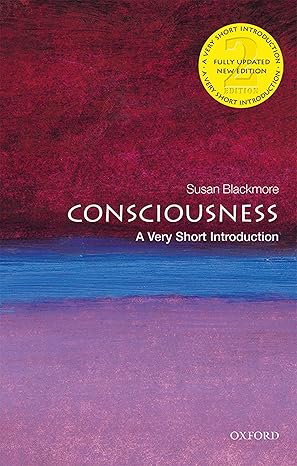
Consciousness: A Very Short Introduction, Susan Blackmore.
If you were confused about what the hell Katherine was talking about, or you simply want to learn more, this could be a great pick for you.
How can a physical brain create our experience of the world? What creates our identity? Do we really have free will? Could consciousness itself be an illusion? Blackmore attempts to answer these questions in this slim volume. Chapter headings include topics like “time and space”, “the self”, and “altered states of consciousness”.
The Very Short Introduction series also covers topics like Buddhism, literary theory, social and cultural anthropology and psychology.
Recent Guides for Thrillers
Creation Lake Book Club Questions and Discussion Guide

Heartwood Book Club Questions and Discussion Guide


Who doesnt love a book club question that starts by asking if you think people who dont fear death are nicer? Its the perfect icebreaker! Seriously though, this list hits all the right notes – from the is this science or magic? debates to the obligatory are we in the Matrix? moment. The reviews are a hoot too, perfectly capturing that 700-page trying to kill me vibe while still praising the breakneck pacing. Its like Brown himself wrote the questions, couldnt he just *tell* us if Katherine is the golem already? 😉 Great fun!