This send-up of the Tradwife life is quite a ride. With Yesteryear, we get a whole lotta unreliable and unlikable character(s), timeline shenanigans, a commentary on influencer culture, a sideways glance at far-right Christian political culture, and 4 cows who can’t catch a break.
Author Caro Claire Burke has positioned the book as a satire, but it also covers some very serious themes like: how ambition can erode common sense and kindness, the corrosive effects of inauthenticity, how familial cosplay can lead to serious child abuse and the damaging effects of untreated mental illness.
Reviews are mixed for this this book, so this isn’t going to be one of those book clubs where you all just say “loved it” and then move on to the wine and cheese. I’m here to help you unpack that conversation with these Yesteryear book club questions. This discussion guide includes 10 discussion prompts, a book synopsis, some (wildly differing) reviews and ideas for what to read next.
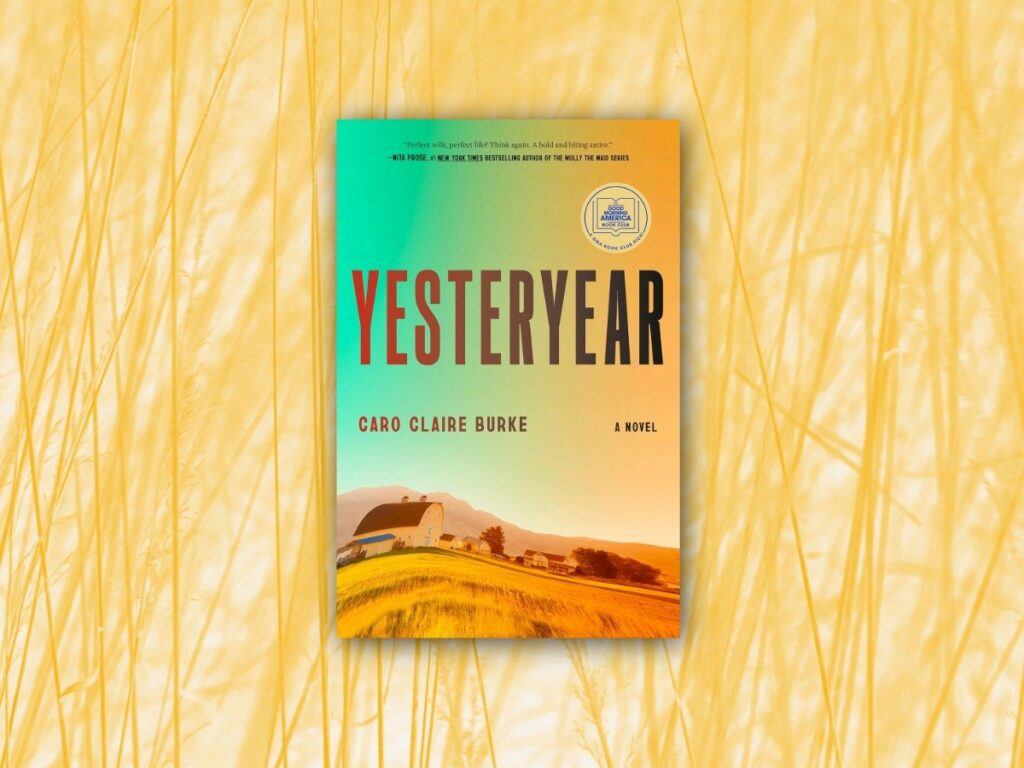
Yesteryear Synopsis
(I always choose to provide the publisher synopsis because I feel that it’s worthwhile to discuss whether the official book description actually squared with your experience of the book.)
Yesteryear, Caro Claire Burke
My name was Natalie Heller Mills, and I was perfect at being alive.
Natalie lives a traditional lifestyle. Her charming farmhouse is rustic, her husband a handsome cowboy, her six children each more delightful than the last. So what if there are nannies and producers behind the scenes, her kitchen hiding industrial-grade fridges and ovens, her husband the heir to a political dynasty? What Natalie’s followers—all 8 million of them—don’t know won’t hurt them. And The Angry Women? The privileged, Ivy League, coastal elite haters who call her an antifeminist iconoclast? They’re sick with jealousy. Because Natalie isn’t simply living the good life, she’s living the ideal—and just so happens to be building an empire from it.
Until one morning she wakes up in a life that isn’t hers. Her home, her husband, her children—they’re all familiar, but something’s off. Her kitchen is warmed by a sputtering fire rather than electricity, her children are dirty and strange, and her soft-handed husband is suddenly a competent farmer. Just yesterday Natalie was curating photos of homemade jam for her Instagram, and now she’s expected to haul firewood and handwash clothes until her fingers bleed. Has she become the unwitting star of a ruthless reality show? Could it really be time travel? Is she being tested by God? By Satan? When Natalie suffers a brutal injury in the woods, she realizes two things: This is not her beautiful life, and she must escape by any means possible.
A gripping, electrifying novel that is as darkly funny as it is frightening, Yesteryear is a gimlet-eyed look at tradition, fame, faith, and the grand performance of womanhood.
10 Book Club Questions for Yesteryear
These questions have been tailored to this book’s specific reading experience, but if you want more ideas, I also have an article with 101 generic book club questions.
- In the opening chapter, you get a monologue from Natalie talking about how she’s such an early riser and how disciplined she is. She then walks into the kitchen where all of her staff and most of her kids are already up and at it. This sets the tone for her as a character. How did you feel about Natalie from the start, and where did you end up?
- Natalie got herself into Harvard hell bent for leather, and wanting a better life for herself. But then she settled for an Mrs. Degree. How did you feel about her choice to drop out of school?
- Who was angrier? The Angry Women, or Natalie?
- The book is meant to be satirical, but for some of the negative reviewers, the satire didn’t quite land. Did it land for you? Or did you read the book with a different lens?
- “Whatever is, is in God, and nothing can exist or be conceived with God”
That quote from Spinoza references his belief in a universal God, one that is the “eternal cause”. But he didn’t believe in the kind of individualized attention from God that many seek through prayer. Natalie, on the other hand, sends very specific prayers to God and (at times) believes that she is receiving specific instruction, grace or messages in return. How do you feel about prayer and individualized divine intervention? Alternatively, how did you feel about the presentation of religious beliefs in the book? - What did you think was going on in the “Old Caleb” timeframe? Time portal? Head injury? Fever dream? The subtle section headers, which indicated past and present give a hint. But did you begin to guess at what was really going on?
- And further, in our normal world, child protective services exist. But they appear not to in this version of Idaho. Was that simply part of the author’s world-building? Or was it a miss?
- Natalie’s mother castigates her for not being nice or kind. But was that really Natalie’s problem? What do you think drove her extreme behavior?
- We’re meant to hate Natalie, but Caleb was neck deep in it. On a 100 point scale, assign a blame score between Natalie and Caleb. Would you carve out some blame points for any other the other characters?
- “And who was I? A flawless Christian woman. The manic pixie American dream girl of this nation’s deepest, darkest fantasies. The mother every woman wanted to be, and the wife every man wanted to come home to. Like a nun in a porno, it didn’t make sense, but also, by God: it worked. My name is Natalie Heller Mills, and I was perfect at being alive.”
There’s the rah-rah self-talk that Natalie projects and then there’s her less “flawless” interior dialog. Will this book make you think differently about any influencers or social accounts that you follow? Do you suspect that some of them have this same sort of split personality? - BONUS QUESTION: Be honest. Has an influencer ever influenced you? Have you bought a product or service, thought differently about a political, cultural or health issue, or added something to that bucket list?
Selected Reviews for Yesteryear
Use these selected Goodreads reviews to compare with your own experience of the book. Do you agree or disagree with the reviews?
‘Was this supposed to funny? Cause I didn’t laugh […] I understand this is supposed to be satire, but it really missed the mark. Satire isn’t just the act of mocking. In order to be effective, it also has to say something of substance. But the problem here is that even when presented with a slew of worthwhile topics, the book instead chose to eschew them all in favor of returning again and again to focus how deranged Natalie is, all the while punishing her for her views.”
” […] Still, the book is unforgettable. Natalie’s voice is fascinating. She is obsessed with being good, likable, obedient, and morally pure, yet those very traits trap her in misery. The novel brilliantly shows how everyone in this story believes they are right while being deeply wrong at the same time. They are all both victims and villains of their own choices. The final twist is wild, slightly far fetched, but devastatingly effective.”
” […] This is where the book’s lack of depth becomes most apparent. It raises big ideas—patriarchy, religion, influencer capitalism—but doesn’t sustain a rigorous exploration of them. The 1855 world, which could function as a material critique of gendered labor and dependence, becomes symbolic instead. And while symbolism can be powerful, in Yesteryear it feels like a retreat from the harder, more uncomfortable questions about compliancy, participation, and power.
“Tradwife culture meets “Shutter Island” with a dash of Amy from “Gone Girl”. The protagonist (heroine is the wrong word) is frankly despicable but that doesn’t mean her cutting observations on the pressure of being female and living up under the weight of expectation on women doesn’t have a bite of wince-inducing truth. Toxic and mesmerizing–I’ll be thinking about this one for a long time.”
“There is so much commentary on religion and conservatism and thus it is no shock that Natalie is a character flawed in her logic but is somehow so fascinating to follow. Begging the question as to whether she truly is as problematic as she seems or is she simply a product of her upbringing, of her values and more so of being a woman in this world?”
What to Read Next
Here are a few books that touch on Yesteryear’s themes or multi-timeline. Each has a link to a book club guide which includes a non-spoiler synopsis toward the top of the page and a link to Amazon for pricing and reviews.
- The Names: A woman navigates a difficult (and deadly) spouse abuse situation with a then and now plot device.
- I’m Glad My Mom Died: Jeanette McCurdy’s memoir exposes years of abuse by a Hollywood stage mom, who makes Natalie look like a peach.
- The Great Alone: Things go very badly for this family in remote Alaska.
- Broken Country: Serious family secrets are simmering on this farm.
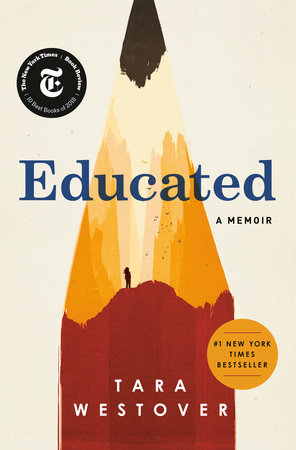
Educated, Tara Westover
While reading Yesteryear, this memoir popped into my head immediately as an excellent comp.
Westover grew up in the sticks of Northern Utah in a fundamentalist Mormon family that didn’t much believe in education. She had a tyrannical mentally ill father, an inattentive mother and a cruel brother.
She struggled to overcome the odds by educating herself and getting out of Dodge. This book has a well-written narrative arc and lots of feels.
Read this one for book club and use our Educated discussion guide.
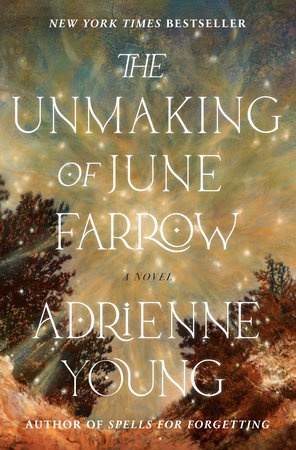
The Unmaking of June Farrow, Adrienne Young
June Farrow offers a family story with a similarly disorienting timeline element, but without the child abuse. Although…there is a curse.
Time flows differently in Jasper, North Carolina than it does at your house…and June Farrow is in the thick of it. There is a “curse” on the women in June’s family. She initially believes it to be mental illness, but fairly quickly this turns into a time travel tale.
As June move back and forth in time, she’s motivated to protect those that she loves and finally break the curse that has so upended multiple generations of her family. The rules of time travel in this book are very particular and it works nothing like other time-travel books that you may have read, making this book a chewy book club read.
Here’s the discussion guide for The Unmaking of June Farrow.
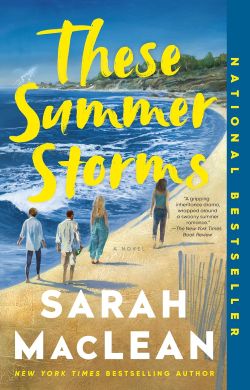
These Summer Storms, Sarah MacLean
If while reading Yesteryear you were thinking to yourself “wow, Doug has way too much money on his hands” and then you grinned a bit at his political takedown, this could be your next read.
In the wake of their father’s death, the Storm siblings are headed back to the funeral, which is at their family summer home on a private island in Rhode Island. But even from the grave, he has some games to play and his will sets some difficult and emotionally fraught tasks that each sibling needs to complete in order to achieve their inheritance.
The book is chock full of family disfunction and dishy rich people problems.
Recent Contemporary Lit Guides
Whistler Book Club Questions and Discussion Guide

John of John Book Club Questions & Discussion Guide
Mad Mabel Book Club Questions and Discussion Guide
Half His Age Book Club Questions and Discussion Guide