
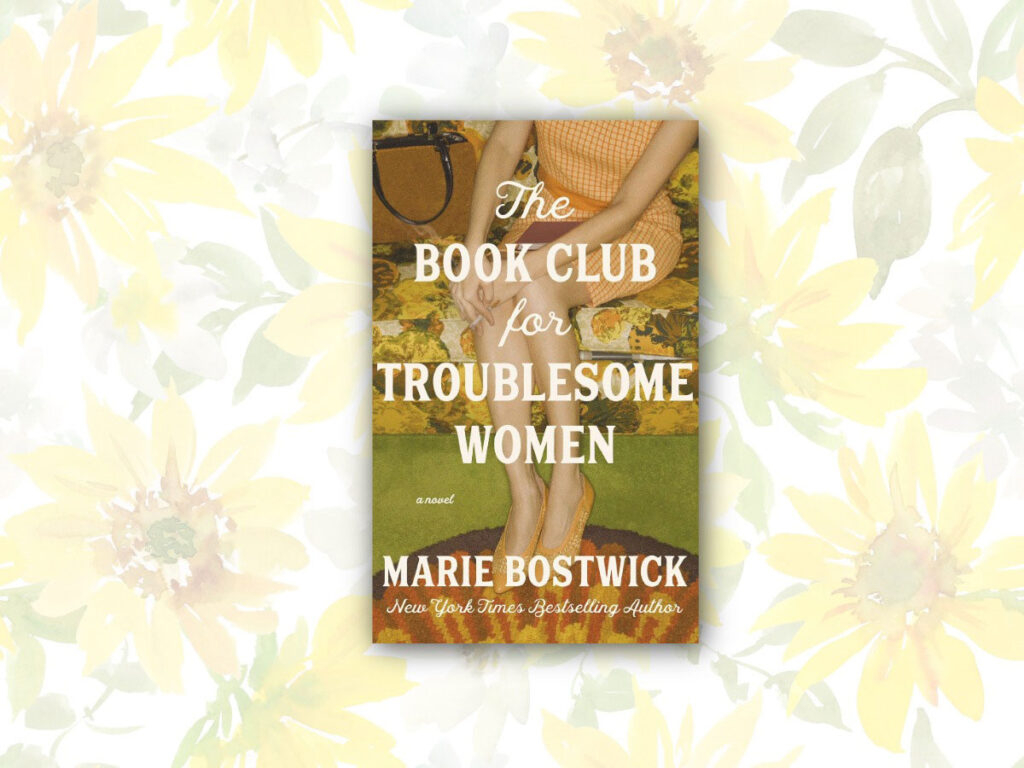
If your book club enjoys a book centered around kinship and women supporting each other, then The Book Club for Troublesome Women is perfect for your group. This story is set in 1960s suburban Virginia. Four housewives form a book club that changes their lives forever after reading Friedan’s The Feminine Mystique. The Book Club for Troublesome Women’s central themes are how pervasive gender discrimination and oppression can be, the importance of community among women, and the empowering nature of storytelling.
Be prepared for a stimulating conversation between your group using these book club questions for The Book Club for Troublesome Women. This discussion guide also features more fodder for discussion, including the book synopsis, and some selected reviews. At the end of the guide are some wonderful book suggestions with themes and content similar to The Book Club for Troublesome Women.
(This article contains affiliate links. This means that if you choose to purchase, I’ll make a small commission.)
Synopsis for The Book Club for Troublesome Women
(I always choose to provide the publisher synopsis because I feel that it’s worthwhile to discuss whether the official book description actually squared with your experience of the book.)
The Book Club for Troublesome Women, Marie Bostwick
By 1960s standards, Margaret Ryan is living the American woman’s dream. She has a husband, three children, a station wagon, and a home in Concordia–one of Northern Virginia’s most exclusive and picturesque suburbs. She has a standing invitation to the neighborhood coffee klatch, and now, thanks to her husband, a new subscription to A Woman’s Place–a magazine that tells housewives like Margaret exactly who to be and what to buy. On paper, she has it all. So why doesn’t that feel like enough?
Margaret is thrown for a loop when she first meets Charlotte Gustafson, Concordia’s newest and most intriguing resident. As an excuse to be in the mysterious Charlotte’s orbit, Margaret concocts a book club get-together and invites two other neighborhood women–Bitsy and Viv–to the inaugural meeting. As the women share secrets, cocktails, and their honest reactions to the controversial bestseller The Feminine Mystique, they begin to discover that the American dream they’d been sold isn’t all roses and sunshine–and that their secret longing for more is something they share. Nicknaming themselves the Bettys, after Betty Friedan, these four friends have no idea their impromptu club and the books they read together will become the glue that helps them hold fast through tears, triumphs, angst, and arguments–and what will prove to be the most consequential and freeing year of their lives.
10 Book Club Questions for The Book Club for Troublesome Women
These questions have been tailored to this book’s specific reading experience, but if you want more ideas, I also have an article with 101 generic book club questions.
- Aside from their shared experience of being limited by their gender roles, each one of the four women in Bostwick’s novel has a distinct personality and faces unique struggles and challenges, Which Betty’s story did you most relate to, and why? Which one felt the most contrasting from your experiences?
- The Book Club for Troublesome Women takes place in a very specific time in history. Does the book’s ideas and themes continue to hold relevance in modern times? Which ones, and why?
- The author regularly weaves actual historical figures and events into the narrative. How does this strategy influence the tone of the book? Also, what does it contribute to the relatability of the story?
- “On February 19, 1963, a troublesome, imperfect, controversial woman named Betty Friedan published a troublesome, imperfect, controversial book titled The Feminine Mystique. The book didn’t solve the problem. But it did put a name to it, shining a light that helped women who felt isolated and powerless find one another, and their voices. That has been the start of every revolution.”
Bostwick’s novel features a book that changes the lives of the women who read it: Betty Friedan’s The Feminine Mystique. Is there a book or text that has deeply impacted your life the way Friedan’s work did the Bettys? Which one, and how?
- Compare the male characters, Walt and Tony. What similarities do they share, and what role do their differences play in the development of the novel’s themes?
- Reading literature and sharing stories empower the women in the book club to make personal changes in their lives. How could storytelling be used to solve real-world problems today?
- The novel conveys the different ways women react to societal expectations–some quietly, some with rebellion, and some with compromise. What do you like or dislike about how the characters go about it?
- The rules and regulations in Concordia limit even the tiniest decisions, like the color of your shutters or what trees you can plant. Are strict community rules more harmful than helpful, especially for women?
- “The point is less what you think it looks like than how it makes you feel. Good art, the best art, elicits a reaction of some sort, not always a positive one. It might make you feel peaceful or joyful or curious. But it could also make you feel angry or ashamed or afraid. The response will vary from person to person. But if the piece evokes something genuine, even raw, it has fulfilled its purpose.”
Throughout the novel, the author reiterates the importance of women supporting and uplifting other women to ensure that the entire community thrives. How does the novel similarly survey the role of intergenerational change and healing in paving the way for equality?
- The motif of “Betty” becomes a unifying identity for women who challenge the status quo; what are the risks and rewards of adopting a group identity to push for social change, and how might you evaluate whether erecting such communities is effective or could exclude those with different perspectives?
The Book Club for Troublesome Women Book Reviews
Use these selected Goodreads reviews to compare with your own experience of the book. Do you agree or disagree with the reviews?
“I so did not enjoy reading this. So much so that I stayed up past my bedtime last night to finish it just so I would not have to face another day with the thought of having to read this book. It probably isn’t that bad, but it was so dull. I didn’t really like or care about the characters and they really weren’t that troublesome given the title. It read like Hallmark circa 2015 trying to tackle social issues. Ultimately, I was disappointed.”
“Omg! I can’t begin to express how much I loved this book. I’m part of 2 book clubs and the book club from this book is all I’ve ever dreamt of. Female friendships between the most improbable of characters, deep connection and personal growth. Also, the historical setting that makes us realise how far the feminist cause has come as well as how it is still lagging behind… I’ll gather my thoughts in the next few days and try to do this book justice. For now, just know you should run to buy it as soon as it comes out.”
“This was a 3.5 for me, but I’ve rounded up. This is the first pick for my inaugural book club meeting, so while I think some of this narrative was pretty banal and a lot of the character development was a little phony, the underlying themes will make for some great discussion and inspire our food selections. Maybe we will have to call ourselves the Betties.”
“This book really put into perspective what life was like as a women in this time period and how hard it was to do anything that wasn’t a standard women’s position. reading first hand how tough it was to do something other than be a man’s wife made me appreciate everything that I have and everything I am able to do, such as getting a job and a good education. it’s an important reminder that those things are a privilege that some people still don’t get this day and to be grateful for them even when I complain about it.”
“This book was pretty boring. After reading The Women by Kristen Hannah, it was hard to overlook how under researched this was in comparison. The whole thing read like an after school special. The protagonists were always in the right and anyone causing problems was one dimensional. The plot felt contrived and self-congratulatory, so it was also predictable.”
What to Read Next
We’ve got quite a few book club guides that deal with patriarchy and female agency. All of the guides below have a non-spoiler synopsis toward the top of the article with a link out to Amazon reviews and pricing
- The Testaments, Margaret Atwood: sequel to The Handmaids Tale.
- Outlawed, Anna North: speculutive fiction set in the late 1800’s about a woman on the run from traditional expectations regarding marriage and childbearing.
- The Women, Kristin Hannah: Army nurses who served in Vietnam are gaslit upon their return.
- The House of Eve, Sadeqa Johnson: Set in the 1950’s, featuring themes like the weaponization of women’s bodies, the importance of second chances, and the ways in which gender, racism, and poverty affect women’s options.
And here are a few other ideas for you:

The Martha’s Vineyard Beach and Book Club, Martha Hall Kelly
A historical fiction novel with two timelines that reveal the enduring power of books and the secrets that can bind families. An enthralling story set on the beachy shores of Martha’s Vineyard. The key themes of the novel are; the role of storytelling and book clubs as a source of hope and comfort, the complexity of family bonds, and the impact of secrets on a tight-knit community.

The Wartime Book Club, Kate Thompson
In the hellish years of WWII, the library became a tangible symbol of resistance. The Wartime Book Club is a story of wartime employment, friendship, bravery, fortitude, and the power and joy of books. This riveting novel explores the devastating effects of war and occupation, the importance of community, and the impact of censorship on morale and freedom.

Angry Housewives Eating Bon Bons: A Novel, Lorna Landvik
An engaging novel about a group of women who form a book group they call AHEB (Angry Housewives Eating Bon Bons), an unofficial “club” that becomes much more to these women, lasting forty eventful years. Some of the key themes are; overcoming personal struggles like abuse, secrets, and loss, as well as the importance of laughter, forgiveness, and second chances in life.
More Historical Fiction Guides
The Calamity Club Book Club Questions and Discussion Guide
The Full Read With Jenna Book List (Rated!)


Best Book Club Books: 2026 Edition