
Prepare to dive into the captivating world of The Calamity Club alongside your book club. Set against the stark backdrop of the Great Depression, The Calamity Club tells the story of a fiercely determined group of women who forge an unexpected sisterhood. Together, they weather adversity and challenge the suffocating social rules of their era. At its heart, the novel explores the power of chosen family, the strength of women, and the illusion of moral perfection.
If your book club is diving into The Calamity Club, these book club questions are designed to spark a lively conversation about its unforgettable characters, rich themes, vivid historical setting, and emotional impact. The Calamity Club discussion guide not only offers a captivating synopsis and handpicked reviews from fellow readers but also concludes with a treasure trove of book recommendations for those who loved The Calamity Club.
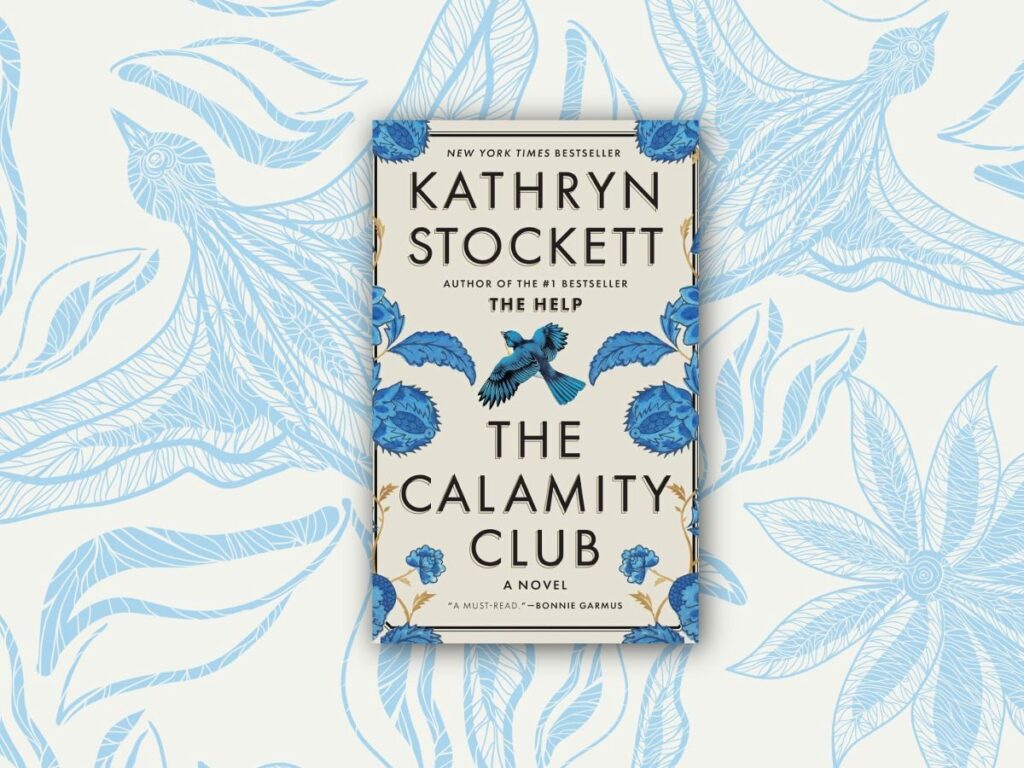
(This article contains affiliate links. This means that if you choose to purchase, I’ll make a small commission.)
Synopsis for The Calamity Club
(I always choose to provide the publisher synopsis because I feel that it’s worthwhile to discuss whether the official book description actually squared with your experience of the book.)
The Calamity Club, Kathyrn Stockett
Oxford, Mississippi, 1933.
Abandoned by her mother one Christmas Eve, eleven-year-old Meg Lefleur has learned the hard way to rely on no one. Now one of the unadoptable “big girls” at the Lafayette County Orphan Asylum, she fights each day to keep her spirit unbowed.
Birdie Calhoun, unmarried and outspoken, has come to Oxford to ask her socialite sister to help the struggling family she’s left behind. But as the Depression tightens its grip, Birdie discovers her sister’s seemingly charmed life is a tapestry of lies.
Then, Birdie encounters Charlie, a woman running low on luck with little left to lose. When their fates—and Meg’s—converge, Charlie comes up with an audacious plan for them to take control of their lives. But in a place and time where hypocrisy is rife and women’s freedom is fragile, even the smallest act of defiance can have dangerous consequences.
The Calamity Club will make you laugh, cry, and cheer—an epic testament to underestimated women who know that calamity can be the spark of new beginnings. This is Kathryn Stockett at her most confident, heartfelt, and hilarious—the triumphant return of one of the most beloved storytellers of our time.
10 Book Club Questions for The Calamity Club
- Analyze how the novel portrays female experience and oppression in 1930s Mississippi. In what ways does Stockett illustrate the realities faced by women during this period?
- Compared to Stockett’s popular The Help, In what ways does the Calamity Club show a deliberate change in how she represents marginalized voices and the difficult history of the South?
- Analyze how the novel portrays sex work and the challenges people in this field experience. How does Stockett use language to address or challenge stigma?
- In what ways did the dual-narrator structure of the novel influence your reading experience? Did you connect more strongly with one narrator’s perspective?
- Which character’s transformation was most unexpected to you, and how does their development illustrate the pressures present in their environment?
- “In the entryway, a large sign read Welcome to the Lafayette County Orphan Asylum for Girls and then listed all God’s children that, in fact, were not welcome.”
This quote exposes the orphanage’s double standards, highlighting the stark contrast between its polished image and the reality faced by the children inside. In what ways does the orphanage’s sign spotlight the chasm between its promises and its actions, and what deeper truths about hypocrisy does this contradiction reveal?
- In what ways does the novel show the difference between lies that cause harm and lies that are meant to protect? Is there a moment when the characters’ lies seem morally wrong to you?
- The Tartt mansion undergoes a dramatic transformation throughout the novel. How does the house itself serve as a character, mirroring the family’s fall from grace?
- How does gradually uncovering Garnett Pittman’s private motivations add complexity and increase her impact as a frightening antagonist?
- “But here is what I’ve come to know: If you give a girl a taste of fresh air and then take it away, she will grow fierce and wild to get that fresh air back again.”
Think back to a time when standing up for someone else revealed a hidden well of strength or bravery within you. How does Birdie’s path mirror your own discoveries? - BONUS QUESTION: How do the male characters embody various aspects of masculinity in this patriarchal society? How do their actions either reinforce or challenge the systems that oppress the female characters?
Selected Reviews for The Calamity Club
“5 ⭐️ This one of the easiest 5 stars I’ve given recently ! I loved this book! From the setting in 1933 Mississippi to the varied and well fleshed out characters, I was drawn in and could not turn pages fast enough. The Deep South of the era came to life with the sights and sounds, the heat and humidity and hardships of the time.”
“I must have gone in with too high of expectations. First half of the book was very good- the last half was not so much. The only character I really liked was Meg. There are too many serious issues dealt with to do justice to any of them properly, in my opinion. I also did not feel that the dialogue used was in keeping with how ladies, or for that matter, an 11 year old girl, talked in Mississippi 1933.”
“Meh. I don’t get the hype. A Hallmark movie in a book. Entirely too long with unnecessary dialogue. I’d find myself drifting off into other thoughts while listening, and didn’t miss much. The author has the main character deal with every social issue of the time period, as well as throw in a few from 2026. Virtue signaling to ensure she doesn’t get the same blowback as The Help.”
“Mixed feelings about this book. I utterly adored the characters, the way the author constructs people is so skillful, they feel like your new best friends (or maybe not, Frances I am looking at you). The interwoven stories, the ending, it all felt very considered and satisfyingly neat. However, ultimately, for me 650 pages of this did just felt a bit too much of a slog. If it had been 200 pages less this would’ve been a full five stars.”
What to Read Next
If you’re keen to read more historical fiction in this time period have a look at West With Giraffes, which is a road trip story. Hang the Moon is set a bit earlier but also features a Southern setting. Kin features friendship and destiny. And House of Eve comes a bit later but also deals with female characters trying to take control of their destinies.
Each of the links go to one of my discussion guide which have a non-spoiler synopsis toward the top of the article.
Here are a few other ideas:

The Dutch House, Ann Patchett
Over the course of fifty years, this sweeping family drama traces the intertwined journeys of a brother and sister cast aside by those meant to protect them. Much like The Calamity Club, The Dutch House draws readers into a world textured by the ache of a missing mother. As the siblings cling to each other and build new families, hope and healing slowly take root, blossoming from the cracks of their shared past.
Here’s a discussion guide for The Dutch House.

Peace Like a River, Leif Enger
The narrative centers on a father navigating life with his three children in 1960s Minnesota. Consistent with the Calamity Club’s adventurous ethos, Peace Like a River immerses readers in a richly detailed historical setting where families confront adversity together, and hope persists even during the most challenging times.

This Tender Land, William Kent Krueger
Set during the Great Depression, the narrative follows four orphans as they navigate their individual journeys. This Tender Land presents a compelling historical account in which families unite to overcome adversity, maternal love is emphasized, and hope persists throughout even the most challenging circumstances.
Recent Historical Fiction Guides
Kin Book Club Questions and Discussion Guide

Land Book Club Questions and Discussion Guide

The Calamity Club Book Club Questions and Discussion Guide

Buckeye Book Club Questions & Discuss Guide