Despite Jill’s efforts to comfort KJ on his deathbed, it was one chaotic scene. There were spirits coming and going, a loud wedding going on next door, rantings of a French climate activist, family confrontations and most of all, denial of a sort that ain’t just a river in Egypt.
Phew, Vigil was quite a ride.
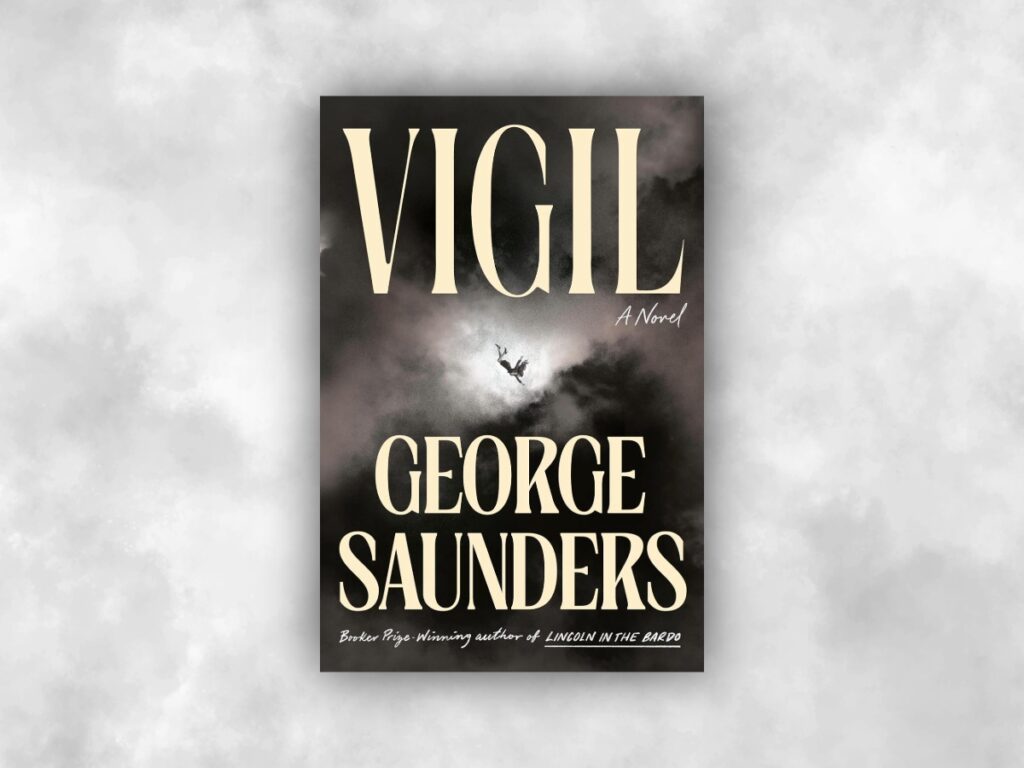
Did I even need to write this Vigil discussion guide? ‘Cause I’ll bet that your book club will find plenty to talk about. But, in order to help you get the conversation moving, I’ve developed these Vigil book club questions anyway. This guide also features a synopsis, some selected reviews (spoiler: not everyone loved it), and some related (and weird and absurd and conceptual) reads.
Let’s get started!
(This article contains affiliate links. This means that if you choose to purchase, I’ll make a small commission.)
Vigil Synopsis
(I always choose to provide the publisher synopsis because I feel that it’s worthwhile to discuss whether the official book description actually squared with your experience of the book.)
Vigil, George Saunders
Not for the first time, Jill “Doll” Blaine finds herself hurtling toward earth, reconstituting as she falls, right down to her favorite black pumps. She plummets towards her newest charge, yet another soul she must usher into the afterlife, and lands headfirst in the circular drive of his ornate mansion.
She has performed this sacred duty 343 times since her own death. Her charges, as a rule, have been greatly comforted in their final moments. But this charge, she soon discovers, isn’t like the others. The powerful K. J. Boone will not be consoled, because he has nothing to regret. He lived a big, bold, epic life, and the world is better for it. Isn’t it?
Vigil transports us, careening, through the wild final evening of a complicated man. Visitors begin to arrive (worldly and otherworldly, alive and dead), clamoring for a reckoning. Birds swarm the dying man’s room; a black calf grazes on the love seat; a man from a distant, drought-ravaged village materializes; two oil-business cronies from decades past show up with chilling plans for Boone’s postdeath future.
With the wisdom, playfulness, and explosive imagination we’ve come to expect, George Saunders takes on the gravest issues of our time—the menace of corporate greed, the toll of capitalism, the environmental perils of progress—and, in the process, spins a tale that encompasses life and death, good and evil, and the thorny question of absolution.
10 Book Club Questions for Vigil
These questions have been tailored to this book’s specific reading experience, but if you want more ideas, I also have an article with 101 generic book club questions.
- Jill means to aid KJ in a comfortable passage. And yet, the comings and goings of all the other spirits create chaos. Do you think death is like that? Comfort and chaos?
- Saunders makes a few interesting formatting choices. The first is that the whole book is one long chapter. The other is that—despite Jill’s absurd use of quotation marks in her reminiscences — Saunders never uses them for dialogue. Did you notice? What was he accomplishing with those choices? Were there other unusual formatting things that I didn’t catch?
- Saunders makes a slow burn of what KJ has done. From the beginning, the Frenchman has his angry screeds but specific mention of climate change is initially oblique and metaphorical. Did you see where Saunders was going from the start? Or did it require more of the journey for you to get there?
- Saunders makes an interesting juxtaposition between endings (KJ’s impending death) and beginnings (the marriage next door), with Jill bouncing between. What did you make of those neighboring narratives?
- Could you see this being made into a movie? Or is it best left as prose?
- Upon encountering her murderer, Jill sees a powerful directive, which is “Comfort. Comfort, for all else is futility” and with this mantra, she sets out to give comfort.
But what about her own comfort? What will it take for Jill to move on? - Mel R describes KJ as “Pigheaded. With an astonishingly limited capacity for self-examination”
Know anyone like that? - “Goodbye beloved hunk of rock, overrun of late with jabbering moronic ingrates.”
KJ is such a charmer! Visualize a current political, cultural or business leader in that bed. Who is it and why? - Both KJ and Jill’s killer rationalize their lies and crimes. Are they of a piece? Or are they fundamentally different?
- Have you ever sat a vigil?
Selected Reviews for Vigil
Use these selected Goodreads reviews to compare with your own experience of the book. Do you agree or disagree with the reviews?
“This book has it all – – wit, incredible insights into the human condition, pathos, satire, and a big (capital B big) theme. At first, the plot itself didn’t really grab me, but slowly, but surely the book gathers momentum and by the end, my authorial crush survived intact.”
“[…] To my great chagrin the story is short in coherence and rich in discrepancy… Spirits come and go… Preposterous and ludicrous… It goes on like a bad séance… And the dying man is a nefarious type… […] If the afterlife is so inane, who will need it then?”
Well, we don’t have to discuss whether Saunders can write – of course he can – but this cutesy and simplistic tale reaches Bertolt Brecht levels of pedagogical impetus paired with Bewilderment heights of righteous undercomplexity. The main narrative idea is almost identical with Lincoln in the Bardo: Once more, we encounter souls caught in the liminal state between death and the afterlife, but in “Vigil”, the center is not a deceased US President, but Ebenezer Scrooge, ähem, K. J. Boone, an oil magnate refusing to repent for his sins against the environment. In his dying hours, he becomes the charge of Jill “Doll” Blaine, a ghost in the bardo who is elevated to accompany souls in the process of passing. […] So yes, this is A Christmas Carol minus the Christmas part, with Boone being haunted by the people he has wronged and by his family, alive and dead. […] This didn’t win me over, although I still love Saunders.”
“There’s a lot to chew on and, as in Lincoln in the Bardo, Saunders gives us a complex, thought-provoking set of afterworlds—afterworlds which we see though multiple sets of eyes and not just our industrial titan’s. For me, this really was a book of thought, and I’m still sitting with it several days after finishing it considering its weft and its warp.”
What to Read Next
If you’re interested in exploring more on Climate Fiction, I’ve got a whole list of cli-fi books.
Normally in this section I recommend a handful of my book club guides that carry similar themes or settings. However, Vigil is pretty singular and it’s hard to find a comp for it (although I do have three reccos below where I give it the ole’ college try). So instead, I’m going to recommend three books that have flown under the radar and that I think need more love. Each links to a discussion guide with a non-spoiler synopsis toward the top along with a link to Amazon pricing and reviews.
- How Not to Drown in a Glass of Water: A Latino woman in her late ’50’s gets laid off from her job and essentially tells the story of her life to her unwilling career counselor. The main character’s voice is fantastic and the book is funny and poignant.
- Nothing to See Here: A woman gets roped into becoming a nanny for two children who, when upset, spontaneously burst into flames, much to the chagrin of their political climber of a father. Don’t worry, the kids are fine. Mostly.
- Matrix: Because why not angry lesbian nuns who barricade themselves behind a hedge labyrinth during the time of Eleanor of Aquitaine.
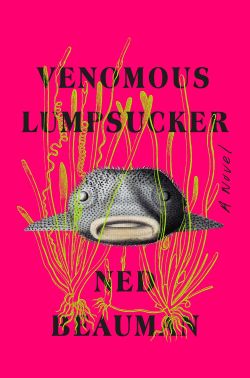
Venomous Lumpsucker, Ned Beauman
It’s the 2030’s and the extractive industries have wreaked environmental disaster and triggered a mass extinction. Sure there’s ubiquitous information flow, social media and nano-technology, but also…no more pandas.
A whole industry has sprung up around preserving what’s left with bio banks and DNA archives. Some folks are earnestly trying to help and others are cynically monetizing the effort. And then, a cyber attack wipes it all out.
Karin and Mark set out to find (and save) the venomous lumpsucker, a small, ugly bottom-feeder with the distinction of being the most intelligent fish on the planet. Along the way, they’re drawn into the mystery surrounding the cyber attack.
And like Vigil, the tone is satirical and absurdist.

The Master and Margarita, Mikhjail Bulgakov (Richard Pevear and Larissa Volokhonsky, Translators)
Over the past 50 years, this novel has achieved cult status. And, like Vigil, it features an absurdist vibe and underworld elements.
While this novel is almost impossible to blurb, I’ll give it a try. The devil and his crew arrive in Soviet Moscow bent upon exposing the greed and hypocrisy of the culture, wreaking havoc in the process. The Master (a persecuted writer) has been imprisoned and Margarita (his love) will do anything to save him, including making a deal with said devil. But wait, there’s also a storyline featuring Pontius Pilate and some satirical commentary contrasting the Christian religion and the atheistic Russian state.
The book is mischievous, dark, rambunctious and weird.

Transcription, Ben Lerner
This book isn’t absurd and it doesn’t feature the devil, climate change, or angry Frenchmen. But Lerner does excel at high concept, so this may be a good fit for you if you want more of that.
On its face, the book is about a man interviewing his brilliant mentor. He’d planned to use his phone to record the interview, but when the phone unexpectedly breaks, he’s forced to wing it and try to chronicle the interview by memory.
But the book isn’t really about that. It’s more a meditation on how we document our lives and the tension between memory, lived experience and recorded “truth”. It also features family dynamics and it explores what it means to be a father.
The book is thoughtful, layered and it features well-crafted dialogue.
Recent Guides in Lit Fic
Whistler Book Club Questions and Discussion Guide

John of John Book Club Questions & Discussion Guide
Mad Mabel Book Club Questions and Discussion Guide

Yesteryear Book Club Questions and Discussion Guide